Showing posts with label Blucher. Show all posts

Wednesday, 11 June 2025

Heliopolis, the first try

This was our first try of the Heliopolis scenario.  We didn't finish the game as we're still not very familiar with the rules but it was a decent test.


Set up initially uses blinds to hide deployment from the enemy.  If the units move they are revealed.  Also, enemy units within 12" of a friendly unit are revealed at the start of your turn.

The French deployed with their cavalry in the centre and advanced towards the forward Ottoman units.

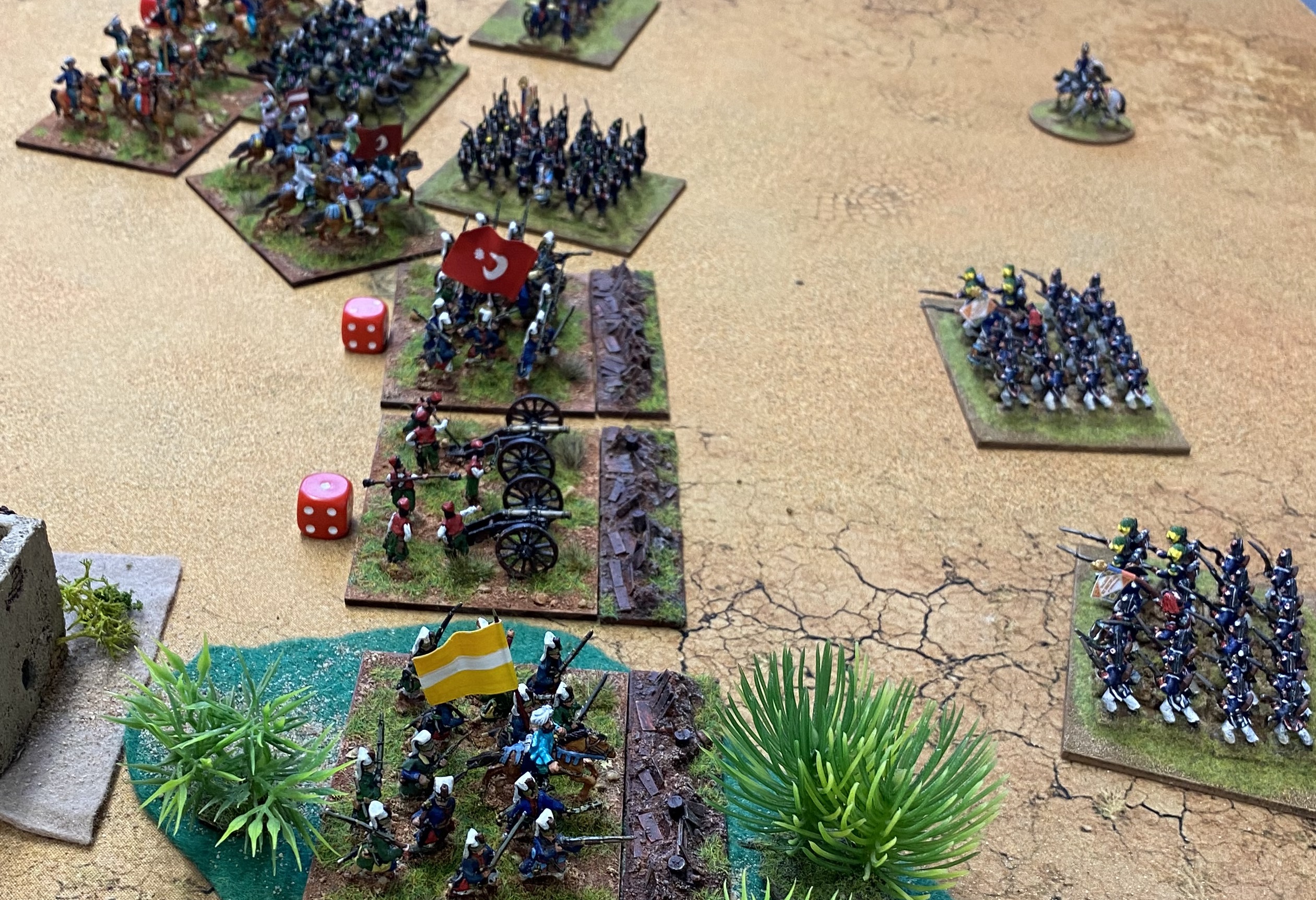
Here, the French are attempting to flank the Janissary trench line, while the Ottoman cavalry launch spoiling attacks.  The Janissaries are losing the resulting firefight.

Two units of Mamelukes gang up on the French dragoons and a unit of Delis charge the flanking infantry. 

French skirmishes and attached artillery firepower breaks the end of the Janissary line.  The Dragoons are thrown back however, and the French infantry hastily form a prepared defence under pressure from the Mamelukes.    

The French infantry on their left storm the trench line and overrun the guns but the village is still help by a garrison of Janissaries.  The unit on the French far left flank held against a Mameluke attack but was forced into a prepared defence.  Another unit of Janissaries charged out of the palm groves and will soon destroy a French demi-brigade in close fighting.  They then pursued the fleeing fusiliers off the southern table edge into Cairo, from where they can raise the Fellahin in revolt.

The French and Ottoman cavalry clash on the right of the field near the ruined mosque.  The Hussars and Chasseurs send some Turkish horsemen packing but the Guides and Dromedaries cannot hold onto their flank.

Lacking infantry support and with the French forming prepared defences the Ottoman horsemen pulled back to regroup with a line of fresh reserves that had come up from the main army.

With time running out and the French heavily on the defensive we called it a day and headed home.

Here are a few bases I knocked up to give the battlefield a bit of ancient character.   They are meant to signify the Roman and Hellenistic ruins that dotted the area.

Not a bad first test.  It remains to be seen if the french can successfully advance in the face so so many sabre wielding horsemen but the rules seem to work well.  We may eventually need to add some house-rules for the "carré d’Egypte." but I think we should persevere with the rules as written for a bit longer. 

Thursday, 29 May 2025

The Battle of Heliopolis, 1800

In the spring of 1800, the French Armée d'Orient was on the defensive. Cut off from Europe by Nelson's victory at the Battle of the Nile and having suffered defeat at the siege of Acre, they were then abandoned by Napoleon who returned to France with his favourites.  Nevertheless, now under the command of the redoubtable Jean-Baptiste Kléber, they were still a formidable fighting force and retained control in Egypt.

By mid March, a newly arrived British army had entered the campaign and peace negotiations had collapsed.  The Sultan's undisciplined but numerous forces, led by the one-eyed Grand Vizier, Yusuf Ziya Pasha, were closing in on the main French base at Cairo.  Despite this strategic weakness, his insecure supply lines, and being badly outnumbered, Kléber opted to go onto the offensive and engage the main Ottoman field army.


The Grand Vizier sent Nassif Pasha with a strong vanguard of Janissaries, reinforced by artillery and cavalry, to block the road out of Cairo at the village of Al Matariyya. Yusuf Ziya Pasha positioned himself further north near the village of Al-Khankah with the rest of the army.

The French advanced north, along the east bank of the Nile, with all the forces Kléber could pull together, and leaving only a skeleton garrison to defend Cairo against the inevitable uprising.

The following map, stats and rules present the historical scenario for the Battle of Heliopolis using the Blucher Napoleonic rules by Sam Mustafa.  

Set Up

Set up the table as shown in the map below. Al Khankah, Saryaqus, Al Marg and Al Matariyyah are urban areas. The green areas are groves of palm trees and count as woods. Birkat al Hajj is an impassable water feature. The ruins count as rough ground. The road is continuous from the north table edge to the south. Units may exit from the southern table edge into Cairo. The Ottomans deploy first. 

The Ottoman Advance Guard must deploy within three base widths of Al Matariyya village. The Janissaries and artillery may be deployed in entrenchments. One infantry unit may be garrisoned in the village. A single cavalry unit from the Cairo Force must deploy within one base width of the ruined mosque. The other units of the Cairo Force must be deployed within three base widths of Al Marg village. One infantry unit may be garrisoned in the village. The main army must be deployed within three base widths of the north table edge. One infantry unit may be garrisoned in the village of Al Khankah.

The The French army must deploy within three base widths of the southern table edge.

The battle starts at dawn with the French taking the first turn.

Victory Conditions

Breaking the opposing army is the primary victory condition.
If both armies exceed their morale in the same turn the game is a draw. 

If neither side's army morale is exceeded, victory is based on control of objectives and the Ottoman units that have exited the southern map edge into Cairo.

Count victory points at nightfall, or when both players mutually agree to end the game.

Each broken enemy brigade – 1 point
Control of each village – 3 points
Each unbroken Ottoman unit that exited via the southern table edge – 1 point

The Ottoman Forces

Ottoman Field Army [Army Morale - 8] - [179pts]

CinC Yusuf Ziya Pasha

Advance Guard [1st Corps] - Nassif Pasha - [42pts]
A♠ Janissaries - [Elan 5 Conscript, Impetuous, shock] – [6pts]
2♠ Janissaries - [Elan 5 Conscript, Impetuous, shock] – [6pts]
3♠ Janissaries - [Elan 5 Conscript, Impetuous, shock] – [6pts]
4♠ Provincial Cavalry - [Elan 5 Impetuous] – [6pts]
5♠ Mamelukes - [Elan 6 Impetuous] – [9pts]
6♠ Modern Artillery - [5,4,4,3,2,2 ] – [6pts]

3 Entrenchments [3pts]

Cairo Force [2nd Corps] - Ibrahim Bey - [44pts]
A♣ Mamelukes - [Elan 6 Impetuous] – [9pts]
2♣ Mamelukes - [Elan 6 Impetuous] – [9pts]
3♣ Provincial Cavalry - [Elan 5 Impetuous] – [6pts]
4♣ Provincial Cavalry - [Elan 5 Impetuous] – [6pts]
5♣ Provincial Infantry - [Elan 5 Skirmish, Conscript, Impetuous] – [7pts]
6♣ Provincial Infantry - [Elan 5 Skirmish, Conscript, Impetuous] – [7pts]

Main Army [3rd Corps] - Seraskier Mahomed Pasha – [93pts]
Suvarileri
A♦ Regular Cavalry - [Elan 6 Impetuous] – [9pts]
2
♦ Regular Cavalry - [Elan 6 Impetuous] – [9pts]
3
♦ Regular Cavalry - [Elan 6 Impetuous] – [9pts]
Janissaries
4♦ Janissaries - [Elan 5 Conscript, Impetuous, shock] – [6pts]
5♦ Janissaries - [Elan 5 Conscript, Impetuous, shock] – [6pts]
Topijis
6♦ Modern Artillery - [5,4,4,3,2,2 ] – [6pts]
7♦ Old style Artillery - [4,4,3,3,2,2 Heavy] – [6pts]
Delis
A♥ Provincial Cavalry - [Elan 5 Impetuous] – [6pts]
2♥ Provincial Cavalry - [Elan 5 Impetuous] – [6pts]
3♥ Provincial Cavalry - [Elan 5 Impetuous] – [6pts]
4♥ Provincial Cavalry - [Elan 5 Impetuous] – [6pts]
5♥ Provincial Cavalry - [Elan 5 Impetuous] – [6pts]
Sekhans
6♥ Provincial Infantry - [Elan 5 Skirmish, Conscript, Impetuous] – [7pts]
7♥ Provincial Infantry - [Elan 5 Skirmish, Conscript, Impetuous] – [7pts]
8♥ Provincial Infantry - [Elan 5 Skirmish, Conscript, Impetuous] – [7pts]

The French forces

French Armée d'Orient [Army Morale - 4] – [177pts]
CinC Jean-Baptiste Kléber - [Mobile] – [10pts]

1st Infantry Division [1st Corps)]- Reynier – [78pts]
Brigade 1/1 - Robin
A♠ 22e demi-brigade légère - [Elan 6 Skirmish Attached Artillery] – [14pts]
2♠ 9e demi-brigade de ligne - [Elan 6 Skirmish Attached Artillery] – [14pts]
Brigade 1/2 - Lagrange
3♠ 13e demi-brigade de ligne - [Elan 6 Skirmish Attached Artillery] – [14pts]
4♠ 85e demi-brigade de ligne - [Elan 6 Skirmish Attached Artillery] – [14pts]
Reserve - Songis & Sanson
5♠ Foot Artillery - [5,4,4,3,2,2 Heavy] – [9pts]
6♠ 25e demi-brigade de ligne & Grenadiers - [Elan 6 Skirmish Shock] – [13pts]

2nd Infantry Division [2nd Corps] - Friant – [56pts]
Brigade 2/1 - Belliard
A♥ 21e demi-brigade légère - [Elan 6 Skirmish Attached Artillery ] – [14pts]
2♥ 88e demi-brigade de ligne - Elan 6 Skirmish Attached Artillery – [14pts]
Brigade 2/2 - Donzelot
3♥ 61e demi-brigade de ligne - [Elan 6 Skirmish Attached Artillery] – [14pts]
4♥ 75e demi-brigade de ligne - [Elan 6 Skirmish Attached Artillery] – [14pts]

Cavalry  [3rd Corps] - Leclerc d'Ostein – [33pts]
A♦ Horse Artillery - [5,4,4,3,2,2 Mobile] – [9pts]
2♦ Combined Light Cavalry (22e Chasseurs & 7e Hussars) - [Elan 5] – [7pts]
3♦ Combined Dragoons (3e & 14e régiment de dragons) - [Elan 6] – [10pts]
4♦ Régiment de dromadaires & Guides à cheval - [Elan 5] – [7pts]


This is a first draft of the scenario.  I will amend it as and when necessary , especially after play testing. 
Monday, 16 December 2024

The Ottomans finally make it onto the table!

After many years and many false starts my 15mm Ottomans have finally got into action! The dastardly French infidels had invaded Egypt and need seeing off. 

The Ottomans were mine and the lovely French provided by my club mate Tony. We used Sam Mustafa's Blucher rules for the game.  These are grand tactical level, with units representing something from a battalion to a brigade.   This was just a pick up learning game, so the scenario was very basic.

There was some glory for both sides. The Sipahis caught a French unit moving in the open and damaged but didn't break it. So they fell back and the following Janissaries closed in on what was left.

The Janissaries broke the Frenchmen and pursued them impetuously.


A French counterattack then threw back half their number, while the supporting Arnauts skirmished with some French light infantry over the village.

On the other flank Ottoman and French cavalry clashed with mixed honours. First more regular imperial Sipahis sent the French dragoons reeling back.


But French counter attacks sent half of them back alongside their armoured supports.  Reserves seem to be very important in this game.

So far we have enjoyed the rules but will now be re-reading to find what we played wrong.

Wednesday, 14 February 2024

Ottoman Vassals

This is the third batch of my 15mm Napoleonic Ottoman army.  This time the units represent the forces of the empire's vassal states.


These Mamluks were a class of slave soldiers found across the middle east but especially associated with Syria and Egypt.  They formed units of fierce cavalry and were famed for their skill and courage.

Palestinian or Syrian soldiers like these would have served in the armies of powerful Ayans like Jazzar Pasha, who fought Napoleon at the Siege of Acre


These Delis are the sort of irregular cavalry found serving in the retinues of Asiatic and North African pashas and could be sent to fight for the Sultan when called.

Large numbers of north African Maghrebi mercenaries like these were recruited and found serving throughout the empire.


These figures were originally Cossacks, I think, but I have pressed them into service as some northern horsemen.  Possibly Turkic Yoruks, Wallachians, Moldavians or some sort of Caucasians.  All irregular cavalry in Blucher terms.

Lastly we have someone to lead them all to victory, a senior Pasha with a two-tailed tug standard in true Turkish style.

This is all I have completed so far.  I still have a few additional units to paint up, but they will be added later.

Tuesday, 13 February 2024

Ottoman Irregulars

This is the next batch of 15mm Napoleonic Ottoman soldiers for Blucher rules.  This time they are the irregulars.  These troops would later come to be called Bashi-bazouks, a common theme of 19th century Orientalist painters.

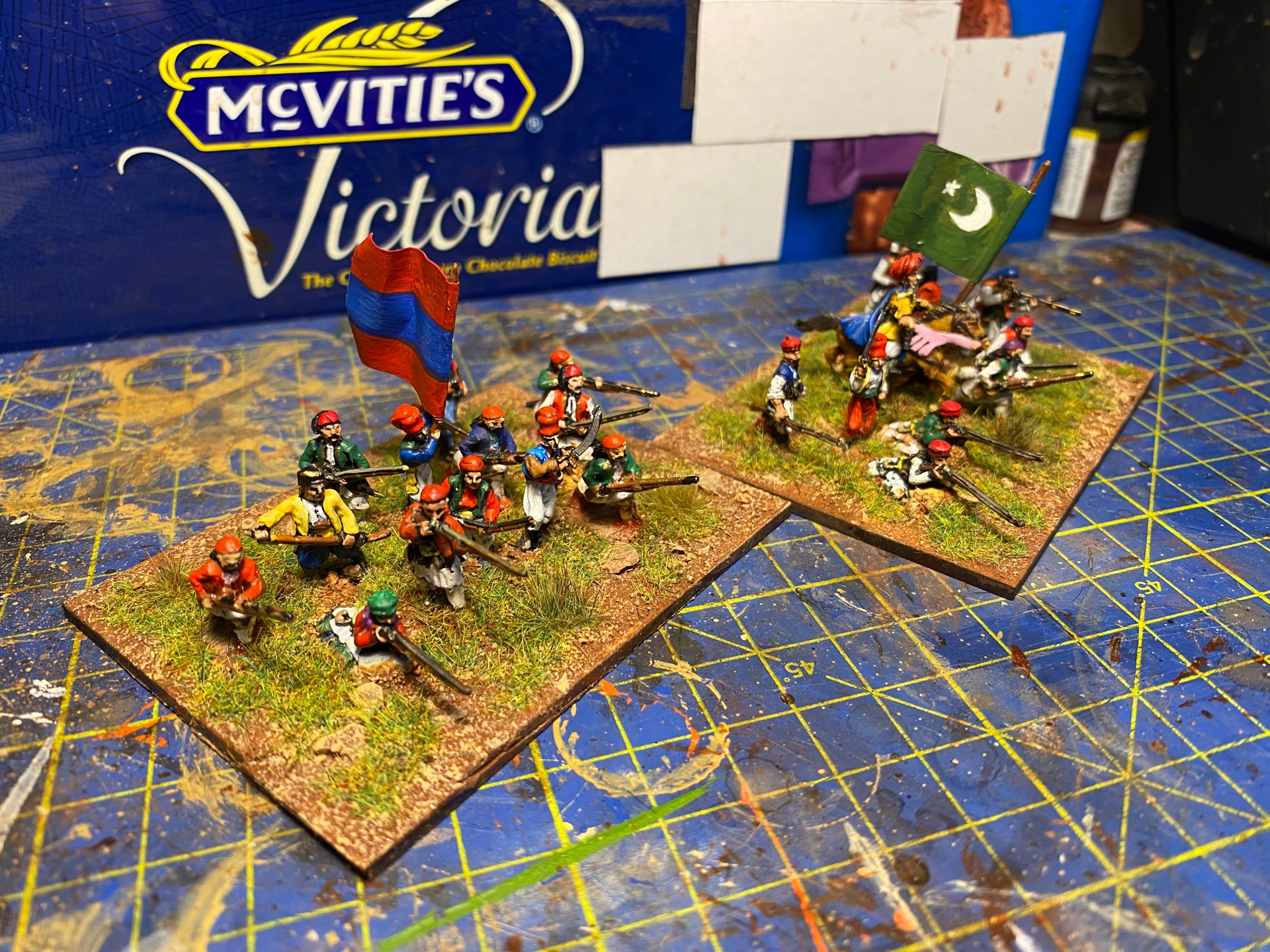
The infantry are Balkan Arnauts, hillmen, bandits and professional mercenaries that would flock to the colours wherever there was fighting. With men like this Muhammad Ali, this one not this one, would take control of Egypt.


These are the last of the Timariot Sipahis.  Once the backbone of the Ottoman field armies and the scourge of Europe they are now little better than a home guard of old men and provincial farmers.

The Ottoman cavalry was more typically now a mercenary force raised by the provincial pashas and greatly expanded with freebooters, adventurers and hangers-on in time of war.  In theory every Muslim male Ottoman citizen was a potential soldier and many would join up with a captain of their choice when war was declared.  These men were hardly an elite but such Ottoman forces could seem to spring from nowhere.

This last pic are some more Delis and a small field battery with old 15mm gunners.  I might replace them at some point or add Snow White to the base.


Coming next are the vassal forces of the empire.

Friday, 9 February 2024

Ottomans Reborn

These poor 15mm Ottomans have been tucked away unused in boxes for many years.  That was, until a few weeks ago when I played a game of Sam Mustafa's Blucher Napoleonic rules with a new club mate.  

I liked the rules, so I thought I would re-base my long neglected Turks.  The rules use big bases and are a large scale big battle game of multi-corps armies, with units representing regiments or groups of battalions. 

This is the first batch of the re-based units from the Kapu Halki, the Sultan's household troops, starting with two regiments, or ortas, of Janissary infantry.  The Janissaries were, by the late 18th century, a pale shadow of their former greatness but still formed the core of the Ottoman infantry.

The household regular cavalry had six regiments and were 10,000 strong in total under Sultan Selim III.  These are the senior regiment, the Sipahis. 

The next regiment are the Silhadars, or 'weapon bearers'. These first two regiments were double size. 

The third and fourth regiments were the Ulufecis or 'salaried men'.  These continued to wear heavy armour into the Napoleonic era.

The household artillery corps, or Topcis, had a mix of traditional pieces and more modern designs, often imported or made to western patterns.  Sultan Selim tried to reform his army, against strong resistance from traditionalists within the empire.  He was most successful with the artillery.

Next up will be the irregular forces like these light infantry from Albania, Greece and Macedonia, known as Arnauts.