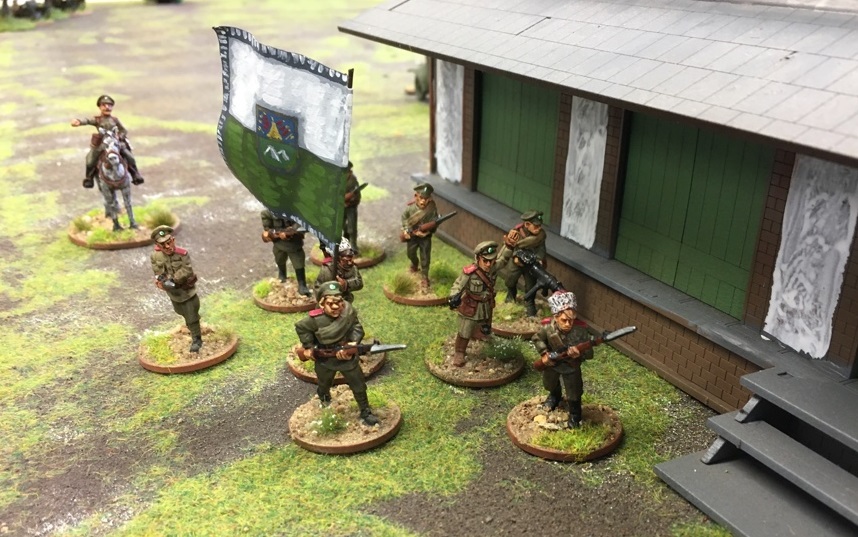
Showing posts with label Siberian Army. Show all posts

Friday, 21 April 2023

Chinese Warlord Debut

Another pair of games with our Back of Beyond forces, including this week a debut outing for the Chinese warlord forces of my club mate Adam.

This first game has a Red force tangling with the Chinese army of Zhang Zongchang, the Dog Meat General himself.


The Bolos were victorious this time but had a hard fight with the Chinese assault troops.

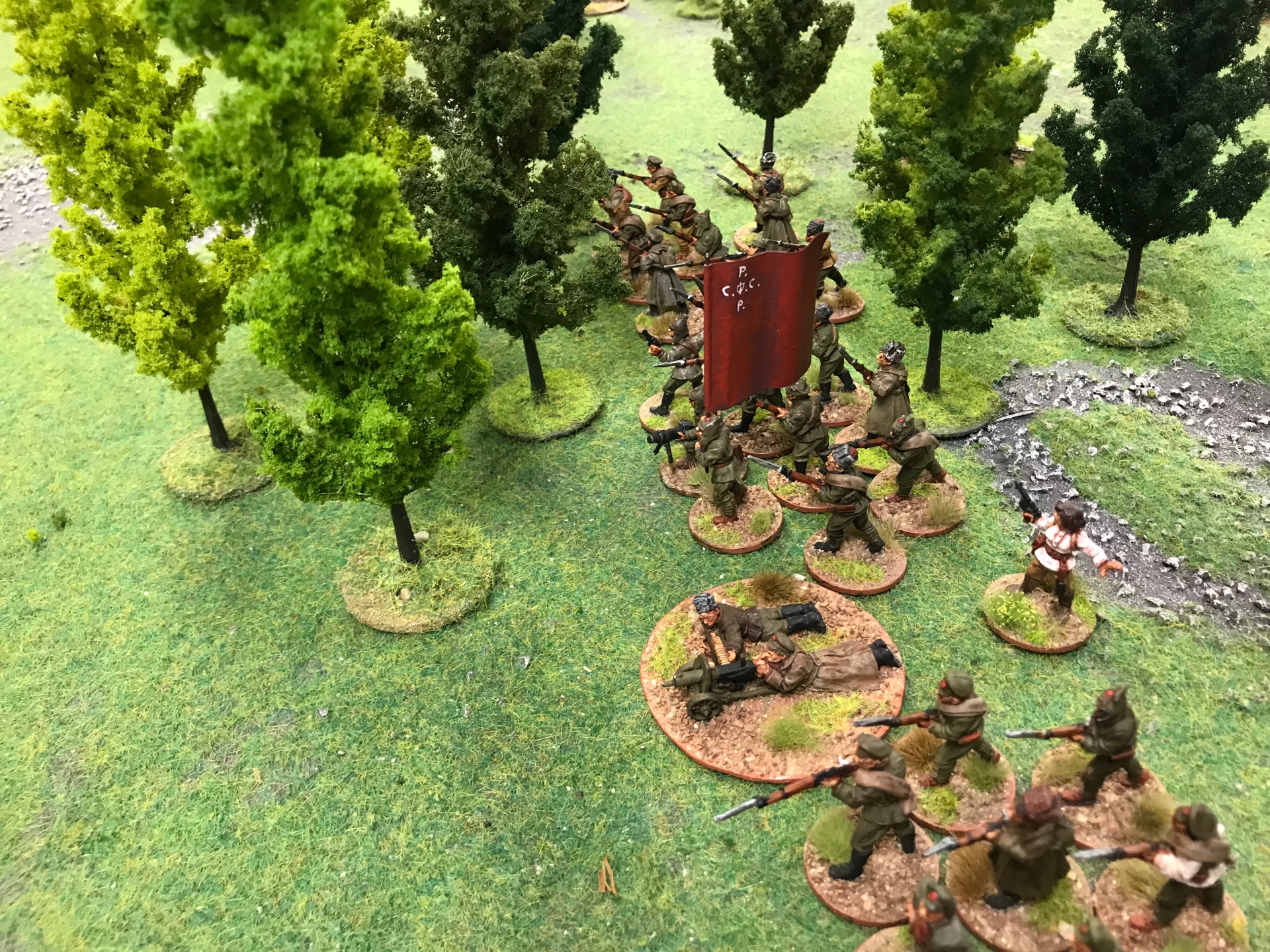
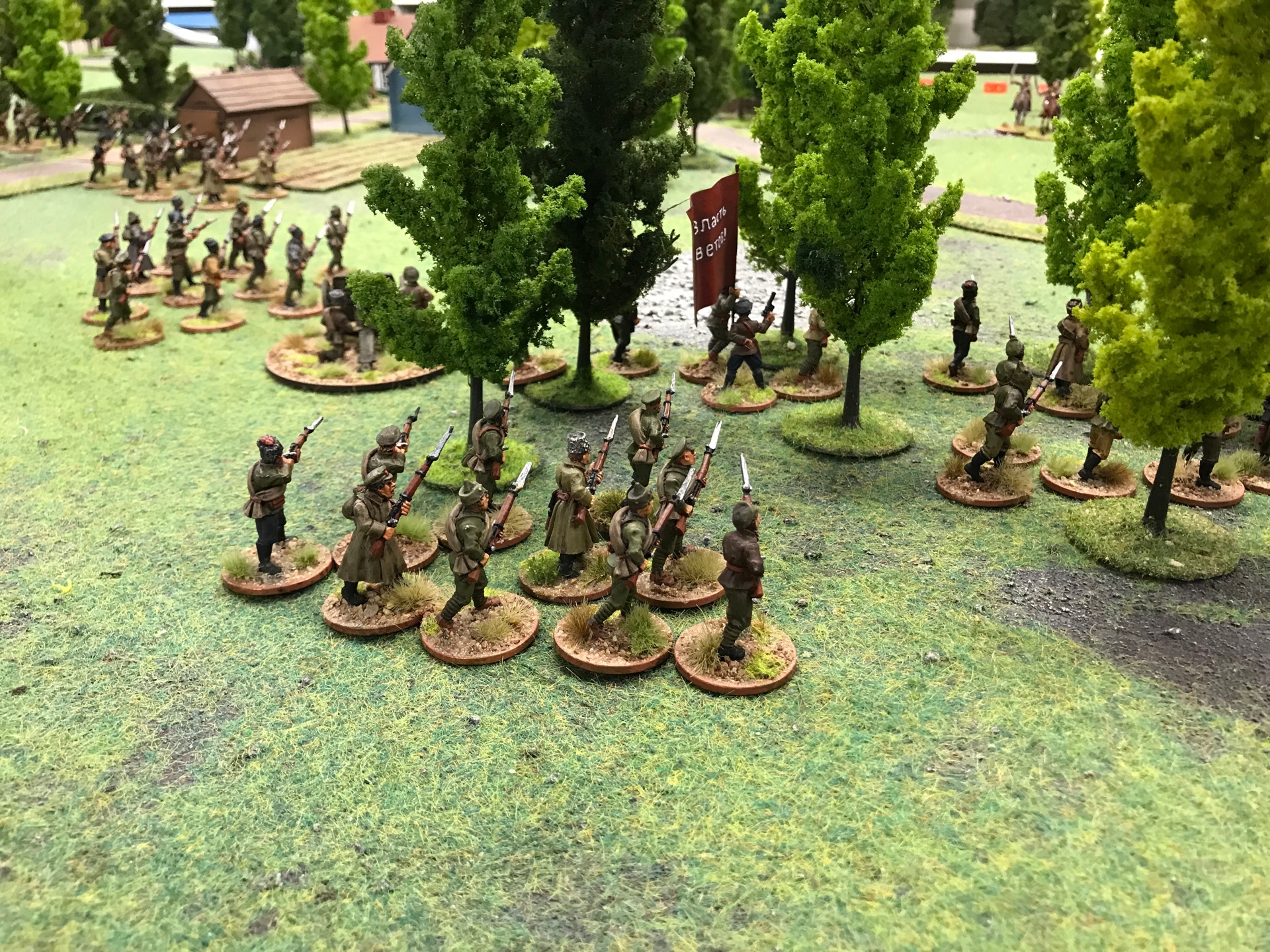
Across the river, we played another game using the bulk of my Red Army forces and Siberian Whites.  


The Bolsheviks were rather pinned down in the woods by some withering firepower from the better trained Siberians.

Both games were play tests for the fast-play Back of Beyond rules we are working on, so that we can play some big games.

Wednesday, 12 April 2023

More Eastern front action

Once again, on the Eastern front of the Russian Civil War, the Bolshevik heroes fight to liberate a village from White tyranny!

This time the game was a test of some rules of our own.  A large force of inexperienced Bolsheviks are attacking a smaller force of the Siberian White Army across the same terrain we used last week.


The game went pretty well for a first try but we have agreed on a few tweaks before we try again with a different scenario.

Thursday, 6 April 2023

Revolution in the Woods

Here are some picture of a 28mm Russian Civil War game from this week.  The Siberian White Army fight a desperate rearguard as they begin their long retreat east in the summer of 1919.


A mixed White force of infantry, artillery and Cossacks try to hold a small hamlet against a Red onslaught.


Inspired by class consciousness and revolutionary justice the Reds come to wipe away the old order.


Things didn't end well for the Whites.  Machine-guns and not kind to cavalry and the White morale collapsed against the unstoppable Red tide.


This game was a trial of using Battlefront WW2 rules for the Russian Civil War in our seemingly endless quest for the perfect rules.

Tuesday, 30 November 2021

Siberian Army Photos

These are some period photos of Admiral Kolchak's forces in Siberia. This first one is the most commonly found in a web search, showing a very ragged and desperate looking bunch.

Their clothes are torn, mismatching and they look either dirty or very sun-tanned.  At least they have footwear, which is better than some of their peers.

These next three shots show troops on review.  In the first, the men are well equipped and very regular with standard issue greatcoats, ammunition pouches and headgear.  The men look recently re-equipped and maybe this was taken in early 1919, before or during the great spring offensive.  The other ranks all wear the distinctive cap with ear flaps that was widely issued in the Siberian army.  No unit insignia can be seen but the striped flag on the right may be the orange and black of St George.  That might indicate these men were raised from the KOMUCH forces, and are just possibly some of the Kappelevtsy.

These troopers below are carrying swords and wearing long boots, so are probably a cavalry unit without their horses. The style of uniforms seems quite consistent but the colouring can be seen to vary a lot, even in this black and white photo.  They are probably still wearing their wartime uniforms or have been equipped from mixed stores.

These appear to be infantry again but don't have standard greatcoats.  Instead they are wearing a sheepskin coat or similar and mostly have standard army caps.  They also look bigger and stronger than the ragged half starved lot we started with.

These next two images show the troops in summer, well clothed and relaxing in the sunshine.  The great variety of styles and colours is noteable.  These photos were probably taken some time in spring or summer 1919 before the great ice march.  Men in both pictures wear a variety of uniform styles and headgear.  Several can be seeen wearing the Siberian caps.  Two-coloured badges or ribbons are visible on their hats, probably the green and white cap badges and ribbons of the Siberian Army.  Shoulder boards can be seen and at least some of them may well be coloured.


This last image has lots of intersting detail.  First the soldiers are very young.  All seem well under eighteen years old, some may be as young as ten or eleven.  Perhaps they were a unit formed from cadets or a school.  However, the boy seated centrally has already had time to earn the medal on his chest.  The award is probably a cross of St George, given for 'undaunted courage'.  So he, at least, may be a veteran of one or more engagements. The boy on the left has his reloading clips threaded through his bandolier for quick access in battle, possibly suggesting he has some experience too. 

Their headgear is mostly animal fur or woolen winter hats, with the medal wearer possibly having a floppy field cap,  Notable is the one boy in a pilotka.  This cap is more synonymous with the later soviet era but was relatively common during the civil war period as well.

Several of the boys have dark, probably black, insignia on their coat lapels and the one wearing a black hat also has a black arm patch, that could be a skull and cross bones.  Almost incredibly, this might indicate that these boys are considered an assault unit.  The grenades and entrenching tools they carry are possible further evdience of this status. 

One last thing to note is that several of the boys carry cut down versions of the standard M91 Mosin three line rifle.  I don't think a true carbine version shorter than the Dragoon model officially existed at this time, so these are probably field variants.  Presumably the unit armourers were trying to help accomodate for the smaller stature of their soldiers.  Experience in WW1 did lead to shorter rifles in the 20s and 30s with some older Mosin rifles being cut down when being reconditioned at the central armouries.  So this might have been a widespread field practice.  However, a full size 7.62x54R bullet in a short carbine rifle has a fierce recoil, due to the reduced weight, and a large muzzle flash, as the powder is not all burned up by the time the bullet leaves the barrel.  See here.

Added notes to correct my suppositions from Cuprum here.

1) Soldiers of the Western army of Kolchak after the fighting. Summer 1919. This state of uniform is typical for both the White and Red Army after prolonged hostilities.

2) Kolchak bypasses the formation of the Siberian Assault Brigade. 1919 year. The black and orange flag really means Army Headquarters.

3) Unknown cavalry unit. It can be assumed with a high degree of probability that these are not Cossacks, but regular cavalry, since their weapons are not of the Cossack type.

4) Kolchak receives a parade of troops in the city of Tobolsk, 1919. The soldiers have wonderful winter uniforms - sheepskin fur coats.

5 - 6) Soldiers of the Siberian Corps (the former army of the Siberian Regional Government).

7) These are cadets of the Siberian Cadet Corps, Omsk. 1919 They had to take part in the battle only during the retreat of the Whites to the Far East. They had to repel the attacks of the Red partisans on the retreating army, which they were part of.

Saturday, 22 August 2020

Siberia 1919

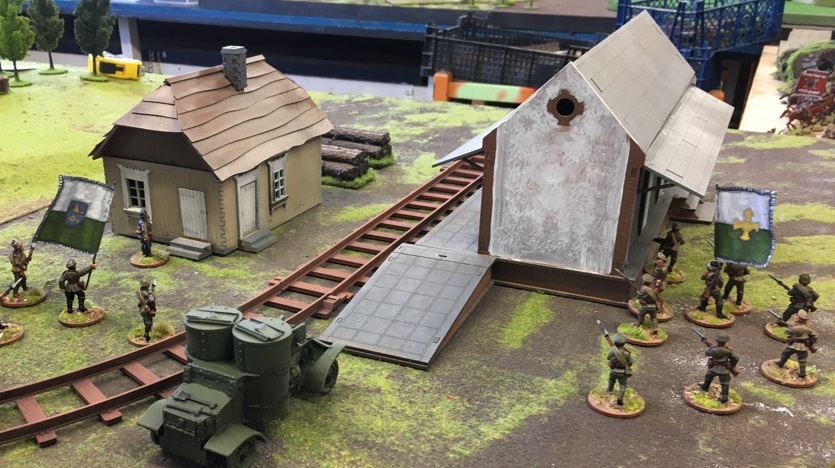
Somewhere on the Russian Civil War's eastern front the White Siberian Army of Admiral Kolchak clashes with Comrade Trotsky's Red Army for control of a vital railway line.


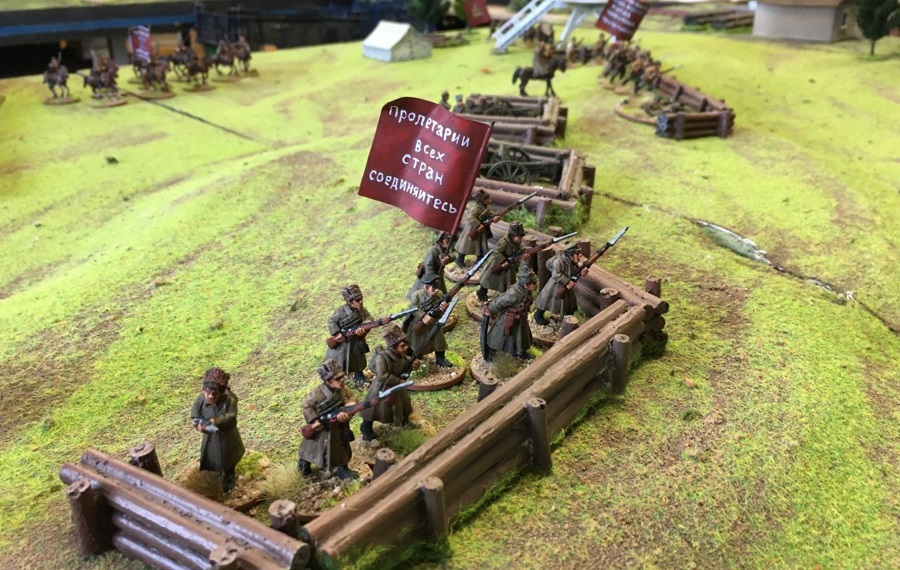
With the Red Guard railway workers defending the station buildings other Red Army forces have dug in on a nearby ridge.


Meanwhile the forces of the reactionary counter-revolution advance from the east.


Comrade Pavlov, commanding the Bolshevik positions, rushes his reserves forward to aid in the defence of the station and the redoubts on the ridge line.


Cossacks and White officers attack the station but are held up by the fierce resistance of the railway workers in the station master's dacha.


Eventually the Red Guards surrender but are all massacred by the victorius Whites.  This is a war with no half measures.


At close of play, intense shelling has driven the Communist Peasant battalion from the ridge and the Whites are pushing on from their victory on the flank.  A unit of internationalist Magyars rushes forward to try to hold the line.


This battle is fictional and while the uniforms are suitable for 1919, the armies are probably more fitting for 1918 in the Railway War period.  We used Setting the East Ablaze 2.0 rules with the following armies. 

Reds

Comrade Pavlov +1 Leader

Red Army Communist Peasant Battalion
10 figs C3 M3 Rifles, Bombs and 1 LMG
Kulomzino Railway Worker Red Guards
10 figs C4 M3 Rifles, Bombs
Moscow Factory Worker Red Guards
10 figs C4 M3 Rifles, Bombs
Tobolsk Food Requisition Detachment
10 figs C4 M4 Rifles, Bombs
Magyar Internationalists
10 figs C3 M3 Rifles Bombs

Tashkent Cavalry Detachment
10 figs C3 M3 Lances, Rifles, Bombs

Artillery Battery 2 x Field Gun C4 M3
1 HMG C3 M3
1 Austin AC C3 M3

Whites

Colonel Verzhbitsky +1 Leader

Omsk Officer detachment
10 figs C3 M3 Ferocious, Rifles, Bombs, 1 LMG
Irtysh Officer detachment
10 figs C3 M3 Ferocious, Rifles, Bombs, 1 LMG
Kurgan Officer detachment
10 figs C3 M3 Ferocious, Rifles, Bombs, 1 LMG
Ishim  Officer detachment
10 figs C3 M3 Ferocious, Rifles, Bombs, 1 LMG

Orenburg Cossack Detachment
10 figs C2 M3 Lances, Rifles, Bombs

Artillery Battery 2 x Field Gun C3 M3
1 HMG C3 M3
1 Austin AC C3 M3