Tuesday, 17 May 2022

Congo Crisis Cinema

Some inspiration and background for the Congo Crisis.  First is the famous footage from the 1966 Italian film Africa Addio


The clip above is a semi-sanitised montage version with Lauren O'Connell's great rendition of the Warren Zevon classic, Roland the Headless Thompson Gunner over the top.  It starts with Mike Hoare talking, moves onto some footage of the CIA backed Cuban emigre airforce, then ends with the attack on Boende by elements of 5 Commando in late 1964.

The full film, titled Africa: Blood and Guts in English, is available on YouTube but be warned it's pretty brutal stuff.  Probably NSFW and definitely not suitable for kids.  The section on the Congo Crisis starts here.

Next is the historical bio-pic of the Siege of Jadotville.  This film is set in the early stages of the crisis during Moise Tshombe’s attempt to have the province of Katanga secede from the newly independent Congo.

A small garrison of Irish UN troops are surrounded and attacked by the European mercenary led Katangese Gendarmerie.

For a bit less reality there is Jack Cardiff's adaptation of the Wilbur Smith novel The Dark of the Sun, also released under that title and as The Mercenaries


A group of mercenaries and Congolese soldiers race to recover a hoard of diamonds, and rescue some stranded settlers on the way, before the advancing Simbas can overrun them.   


They have a pretty good stab at the mercenary uniforms and even the Simbas, which makes for something different from the usual WW2 subject matter for these type of films.
 

There's a nice game of the film over on Lead Adventure Forum here and some other Congo related games here and here.  


Another movie to put on while you paint, is the Wild Geese, for which Mike Hoare was a consultant.  The film clearly draws several themes from the period of the crisis and its aftermath. 


An interesting bit of trivia is that John Kani's character in the film, Jessie Blake (above right), was the inspiration for the Action Man figure, Tom Stone, after designers saw early work on the film.
 
 
Last is the 1980 film The Dogs of War.  This latter was based on the book of the same name by Frederick Forsyth.  Forsyth was accused at one point of genuinely plotting a coup and the book was later described as "a textbook for mercenaries".  Several copycat coups have been attempted including one to take over Equatorial Guinea in 2004 that involved Mark Thatcher, son of the former British PM.
 
 
As a postscript, I have read online some dispute that Thompson submachine guns were used by the mercenaries in the Congo.  I found these two pictures from the period to show they were.


This first shows Spanish mercenaries from 6 Commando with ANC General Bobozo from this interesting photostream here.


The second shows some mercenaries attached to 7 Commando in 1964 from this website here.  A gold mine of excellent photos on the Jeeps used.

Sunday, 8 May 2022

The Congo Crisis

I have made a start on a new project to build some armies based on the extended 1960s Congo Crisis including the 1964 Simba Rebellion and the 1966-7 Stanleyville Mutinies. There are a host of factions and events to model, plus lots of interesting forces and characters.  There are presidential assassinations, post-colonial tyrants, UN peacekeepers, white mercenaries, Marxist rebels, witch doctors, Cuban exiles, Belgian paratroopers, the CIA and even Ernesto "Che" Guevara.  

Patrice Lumumba

The events surrounding the independence of the former Belgian Congo are a horrific human tradegy that has led to decades of civil war across the region but are surprisingly little known about today.  Nevertheless, these 'interesting times', while a nightmare for those involved, make a suitable backdrop for wargames. 

Congo Crisis

Independence saw a very rapid breakdown of order.  An army mutiny and an attempted succession by the province of Katanga resulted in widespread Belgian intervention, the overthrow and execution of the first elected president, Patrice Lumumba, and ultimately the deployment of large numbers of UN peacekeepers.   

Jadotville Irish UN Troops

Significant fighting occurred, especially between the UN forces and the mercenary backed Katanganese gendarmerie.  The most famous incident from this period was the siege and controversial surrender of the Irish UN garrison at Jodotville.

Simba Rebellion Map

By 1964 the Katanganese independence movement had been defeated and the UN mission was over.  The focus then moved to the north east of the country where Lumumbist forces had seized control, declaring the "Free Republic of the Congo" (République Libre du Congo).  These rebels, known as the Simbas, combined a mix of marxism and mysticism to motivate their troops and would certainly make for a very interesting and unique wargames army.

Simbas

The Armée Nationale Congolaise (ANC) under the command of general Joseph-Désiré Mobutu made extensive use of Mercenary forces to spearhead their repression of the Simba rebellion.  Most famously 'Mad Mike' Hoare's 'Wild Geese' of 5 Commando, seen here advancing north to Stanleyville in late 1964.

Mike Hoare's 5 Commando on the advance to Stanleyville in 1964

Belgian Paratroopers simultaneously seized Stanleyville airfield in Operation Dragon Rouge to rescue and evacuate the settlers held by the rebels.

Operation Dragon Rouge

Two brief mutinies by Katanganese and mercenary forces in 1966 and 1967 end the period with their withdrawl into Rawanda,  This left Mobotu firmly in control of the country, which he reanmed Zaire and ruled until deposed in 1997 by forces loyal to the former Simba, Laurent-Désiré Kabila.

Colonel Mobutu

I'm going to use 28mm figures and in that scale the only truly suitable figures for this period are the old Mongrel miniatures Wild Geese, now available from Badger Games in the US.  Although, being Paul Hicks' sculpts they have stood the test of time.  There will however, have to be quite a bit of conversion and artistic licence to give an impression of the forces involved.

Sunday, 20 February 2022

Gunfight in Alanville

This was a game of Fistful of Lead we played recently.  Fast, furious and great fun as always we used the core rules for a western themed showdown.

Wichita Red Robinson and his ruthless band of killers entered Alanville from the north intent on robbing the Scanes Company bank.  

Unfortunately for them, instead of only timid townspeople, they were met by the formidable Dooley Brothers, gamblers, entrepreneurs and sometimes lawmen.


With his Winchester rifle Deuce Davis keeps Virgil pinned down behind the station while the rest of the gang make short work of the other Dooley Brothers.  


In a few short minutes of butal firefight Frank, Morgan and James Dooley are out of action for the loss of only Bronco Sally.  With the main street cleared the gang press on to the bank but one Dooley brother remains.

Virgil Dooley's fame as a skilled and dangerous pistolero is well founded, and the with just two shots he dispatches the outlaws Deuce Davis and Stoke Row Bill. 

Virgil moves quickly down main street to catch Lone Pine McGraw and Wichita Red Robinson in the act of robbing the bank, but he is caught by a hail of lead as they emerge with the money.  With the Marshal down bleeding and alone the frightened townspeople think it's all over.  

Red Robinson walks slowly towards the wounded lawman and fires a shot as Lone Pine takes his chance to run for it.  

However, hubris has gotten the better of this Kansas desperado.  As he shoots, Virgil uses his lightening fast reflexes to dodge the bullet from Red's gun.  Recovering instantly, the Marshal rises to his feet and blasts Red from short range.  The viscious outlaw stares in dsibelief at the spreading red stain on his shirt and crumples to the floor.

We couldn't believe the end, it was straight out of a Hollywood movie, and a fitting finale to another great fun game of FFOL.

Tuesday, 30 November 2021

Siberian Army Photos

These are some period photos of Admiral Kolchak's forces in Siberia. This first one is the most commonly found in a web search, showing a very ragged and desperate looking bunch.

Their clothes are torn, mismatching and they look either dirty or very sun-tanned.  At least they have footwear, which is better than some of their peers.

These next three shots show troops on review.  In the first, the men are well equipped and very regular with standard issue greatcoats, ammunition pouches and headgear.  The men look recently re-equipped and maybe this was taken in early 1919, before or during the great spring offensive.  The other ranks all wear the distinctive cap with ear flaps that was widely issued in the Siberian army.  No unit insignia can be seen but the striped flag on the right may be the orange and black of St George.  That might indicate these men were raised from the KOMUCH forces, and are just possibly some of the Kappelevtsy.

These troopers below are carrying swords and wearing long boots, so are probably a cavalry unit without their horses. The style of uniforms seems quite consistent but the colouring can be seen to vary a lot, even in this black and white photo.  They are probably still wearing their wartime uniforms or have been equipped from mixed stores.

These appear to be infantry again but don't have standard greatcoats.  Instead they are wearing a sheepskin coat or similar and mostly have standard army caps.  They also look bigger and stronger than the ragged half starved lot we started with.

These next two images show the troops in summer, well clothed and relaxing in the sunshine.  The great variety of styles and colours is noteable.  These photos were probably taken some time in spring or summer 1919 before the great ice march.  Men in both pictures wear a variety of uniform styles and headgear.  Several can be seeen wearing the Siberian caps.  Two-coloured badges or ribbons are visible on their hats, probably the green and white cap badges and ribbons of the Siberian Army.  Shoulder boards can be seen and at least some of them may well be coloured.


This last image has lots of intersting detail.  First the soldiers are very young.  All seem well under eighteen years old, some may be as young as ten or eleven.  Perhaps they were a unit formed from cadets or a school.  However, the boy seated centrally has already had time to earn the medal on his chest.  The award is probably a cross of St George, given for 'undaunted courage'.  So he, at least, may be a veteran of one or more engagements. The boy on the left has his reloading clips threaded through his bandolier for quick access in battle, possibly suggesting he has some experience too. 

Their headgear is mostly animal fur or woolen winter hats, with the medal wearer possibly having a floppy field cap,  Notable is the one boy in a pilotka.  This cap is more synonymous with the later soviet era but was relatively common during the civil war period as well.

Several of the boys have dark, probably black, insignia on their coat lapels and the one wearing a black hat also has a black arm patch, that could be a skull and cross bones.  Almost incredibly, this might indicate that these boys are considered an assault unit.  The grenades and entrenching tools they carry are possible further evdience of this status. 

One last thing to note is that several of the boys carry cut down versions of the standard M91 Mosin three line rifle.  I don't think a true carbine version shorter than the Dragoon model officially existed at this time, so these are probably field variants.  Presumably the unit armourers were trying to help accomodate for the smaller stature of their soldiers.  Experience in WW1 did lead to shorter rifles in the 20s and 30s with some older Mosin rifles being cut down when being reconditioned at the central armouries.  So this might have been a widespread field practice.  However, a full size 7.62x54R bullet in a short carbine rifle has a fierce recoil, due to the reduced weight, and a large muzzle flash, as the powder is not all burned up by the time the bullet leaves the barrel.  See here.

Added notes to correct my suppositions from Cuprum here.

1) Soldiers of the Western army of Kolchak after the fighting. Summer 1919. This state of uniform is typical for both the White and Red Army after prolonged hostilities.

2) Kolchak bypasses the formation of the Siberian Assault Brigade. 1919 year. The black and orange flag really means Army Headquarters.

3) Unknown cavalry unit. It can be assumed with a high degree of probability that these are not Cossacks, but regular cavalry, since their weapons are not of the Cossack type.

4) Kolchak receives a parade of troops in the city of Tobolsk, 1919. The soldiers have wonderful winter uniforms - sheepskin fur coats.

5 - 6) Soldiers of the Siberian Corps (the former army of the Siberian Regional Government).

7) These are cadets of the Siberian Cadet Corps, Omsk. 1919 They had to take part in the battle only during the retreat of the Whites to the Far East. They had to repel the attacks of the Red partisans on the retreating army, which they were part of.

Friday, 26 November 2021

Volunteer Army vs Reds Part II

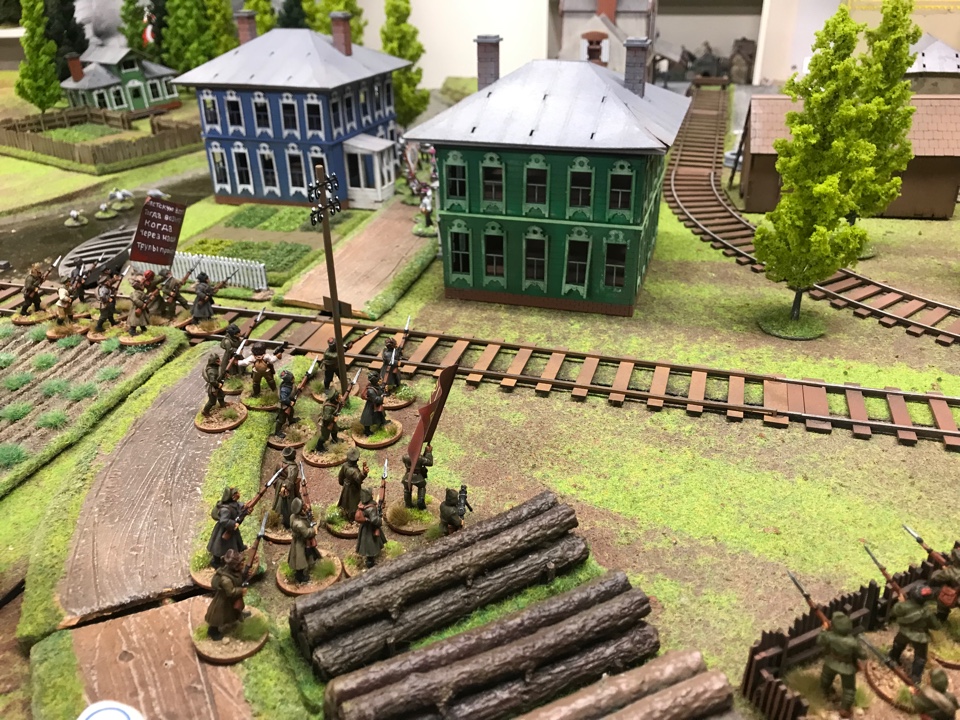
This week we concluded the battle we started last week with the AFSR and Red Army fighting hard for a town in Southern Russia.

The main fighting in the centre saw White Officer companies try to capture and hold the town against a horde of Peasants and Workers with Regular Red Army and some Cheka in Support.  The Whites held the houses but were blasted with rifles, machine guns and artillery from all sides.

On the east flank the Whites crossed the fields and pushed onto the ridge line with cavalry and armoured cars in support to drive the Reds back into the village.


Meanwhile on the Western side of the battle a Red Flank attack swept down on a small hill held by a group of Volunteer Army sailors.


The Sailors fought hard and even stood agaist the cavalry charge but were eventually shot down to a man.

Back in the east the Whites had taken out the Red Arnoured that anchored their line and were pushing on.


The Reds hastily reform in the village to stop the Counter-revolutionary advance in its tracks.


The battle raged in the centre with the Green Dacha finally falling to the victorius reds.  Just long enough for the Cheka to get lots of loot and run off back to party HQ.  While the the heroic martyrs of the revolution litter the blood soaked ground.


Sadly for the Tsarist cause the cavalry did arrive but were pinned down by artillery and maxim fire and didn't really help.

Is this just a set back on the road to victory or has the tide turned on Denikin's depleted forces?